Translated from Norwegian with help from AI.
For thousands of years. humans have harnessed the power of the wind. However, the use of wind energy has not been without its challenges. The history of wind powers is a tale of technological development, a test of democracy, environmental crisis, and the green transition.
WHEN THE WIND TURNED
November 2019: Small, white wooden crosses and a coffin are placed on a slope near County Road 716 on Frøya
A symbol of everything opponents of wind power believe will be lost when the wind power plant on the island is erected. On the other side of the road, a police car is parked, with two officers from the sherrif's department in Orkdal. They have just informed that the residence ban, which also covers the activists' camp on the oppisite side of the road from the ongoing wind power development in Nessadalen, will be enforced.
Entering will prompt a police response.
Empty threats, perhaps others would think. But in Frøya, they know it's true, and now the goal is to get the gas burner, pot, and sausage packs out before the large crowd arrives — preferably without being taken to the police station.

"Motvind" in growth
(«Motvind» translates directly to «headwind» in English. In Norwegian «Mot» also means "Against», «Against wind power» or increasing resistance in this case and thus has a double meaning in Norwegian).
For this is not an ordinary day on Frøya, if one could even talk about anything like that in the last year. On this day, the newly started organization «Motvind» holds its first national meeting in Sistranda, with attendees from all over the country. The local resistance group is the host, has organized a seminar, and planned a field tour.
Throughout the country, wind power opponents have heard horror stories from Frøya. Now they will get to see with their own eyes what has been happening on the outermost edge of Trøndelag.
Among those who have traveled in advance is the local action leader. He himself has experienced what can happen if one does not follow the instructions from the police, and the evening in the Trondheim jail is not something he wishes to repeat. Nevertheless, he hesitates to dance to the police's tune and goes straight into negotiations with the law enforcement officers.
The message from the police is clear:
«If you enter the restricted area, you will have to answer to the authorities.» Politiet, 2019
The furthest they can go is that the action leader and the rest of the vanguard can retrieve the food and drinks so they can gather in the ditch a bit further down the road — where the right of access still applies.

CONFRONTATION
People gathered on Frøya this weekend come from Finnskogen and Jæren, from Bremanger and Vesterålen.
They have different backgrounds and political positions and are likely to be on a collision course on many issues. But on one point, they believe that wind power development in the country must be stopped, and they believe it must happen now.
But first, they themselves will go out and feel how harsh the fronts can become. As new cars park in the ditch and groups of visitors arrive, the assembly chooses to ignore the thereats from the police. In a united flock, they enter their own campsite, just a few meters from where the police still stand their ground.

Only after one of the wind power opponents present, dressed in a black clergy robe and white collar, has walked over to the police and exchanged a few words, does the reaction come. The police representatives straighten up and walk across the road and into the cordoned-off camp area, now filled with wind power opponents.
One of the two police officers raises his voice, probably about to inform about the ban, but no one hears what he says. Suddenly, the assembly breaks into a collective song. Every word from the policeman's mouth drowns in a heartfelt version of «Ja, vi elsker» (the Norwegian national anthem).
The response from the two policement is to approach each person gathered inside the area. They explain the ban and issue fines, and after a while, the assembly disperses — just in time for the planned national meeting and dinner in Sistranda.
VISIBLE INTERVENTION
Like most wind power developments in Norway, there was local support for the project that formed the basis for the development on Frøya.
A small majority of residents voted in favor of the development, and the municipal council made several positive decisions.
Throughout, there were opponents fighting to stop the plans, and for a long time, it didn't seem like the plans would materialize, even though politicians gave their approval. It wasn't until a German power company entered the scene at the turn of 2018/2019, with money to invest, that the possibility of development suddenly became viable.
Then the opposition ignited, and before the actual development started, the political majority on the island reversed.

During the spring of 2019, the conflict in Trøndelag emerged as the first major wind power dispute that garnered national attention over time. For many observing from a distance, through continuous media coverage and increasing activity on social media, the Frøya development appeared as a kind of wake-up call.
One aspect was that the conflict in Trøndelag recieved extensive media coverage, revealing how difficult such a case can become when neighbours are pitted agains each other, and parts of the population feel overruled.
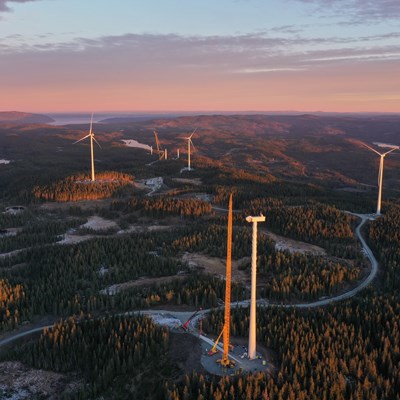
With the press photograpgers also came images from the construction site, where machines carved their way into nature to erect the new power plant. It was no longer sketches and plans but genuine interventions that were clearly visible on TV and in the numerous newspaper reports.
A perfect storm
Whether fighting for untouched nature or reindeer husbandry conditions, bird welfare and public health, or the value of their own properties, an increasing portion of the population in 2019 found themselves asking:
«Is it really worth it?» Folk mot vindkraftutbygging, 2019
At the same time, the Norwegian Water Resources and Energy Directorate (NVE) worked on what would become a national framework for onshore wind power, commissioned by the Ministry of Petroleum and Energy (OED). The work, which included both maps and technical reports, was presented on April 1, 2019 – just when tensions were at their peak in Trøndelag.
Throughout the summer and fall, almost 5,000 responses were recieved in the public consultation. The vast majority were strongly critical of more wind power. The overall opposition was so significant that the case never reached the Parliament.
On October 17, 2019, NRK reported that the government had halted work on the national framework. Prime Minister Erna Solberg explained the decision by stating that the government had listened to the people. At the same time, they announced that there would be tightening of the concession rules for wind power.


What will be the result?
Even though there were differing opinions about what it would mean for the future onshore wind power development in the country when the work on the national framework was halted, one thing is certain: It was a direct result of the increasing resistance among the people. But what is it actually that motivates so many to protest against this particular policy and power development?
Are we now witnessing a continuation of the opposition previously seen during major hydropower developments, or is something entirely different prompting people to react today?